

Free written scope consultation - allowances, timeline, and change-order rules on paper before a single trade is scheduled
Sterling Home Additions & ADU: The Fort Lauderdale Owner’s Guide
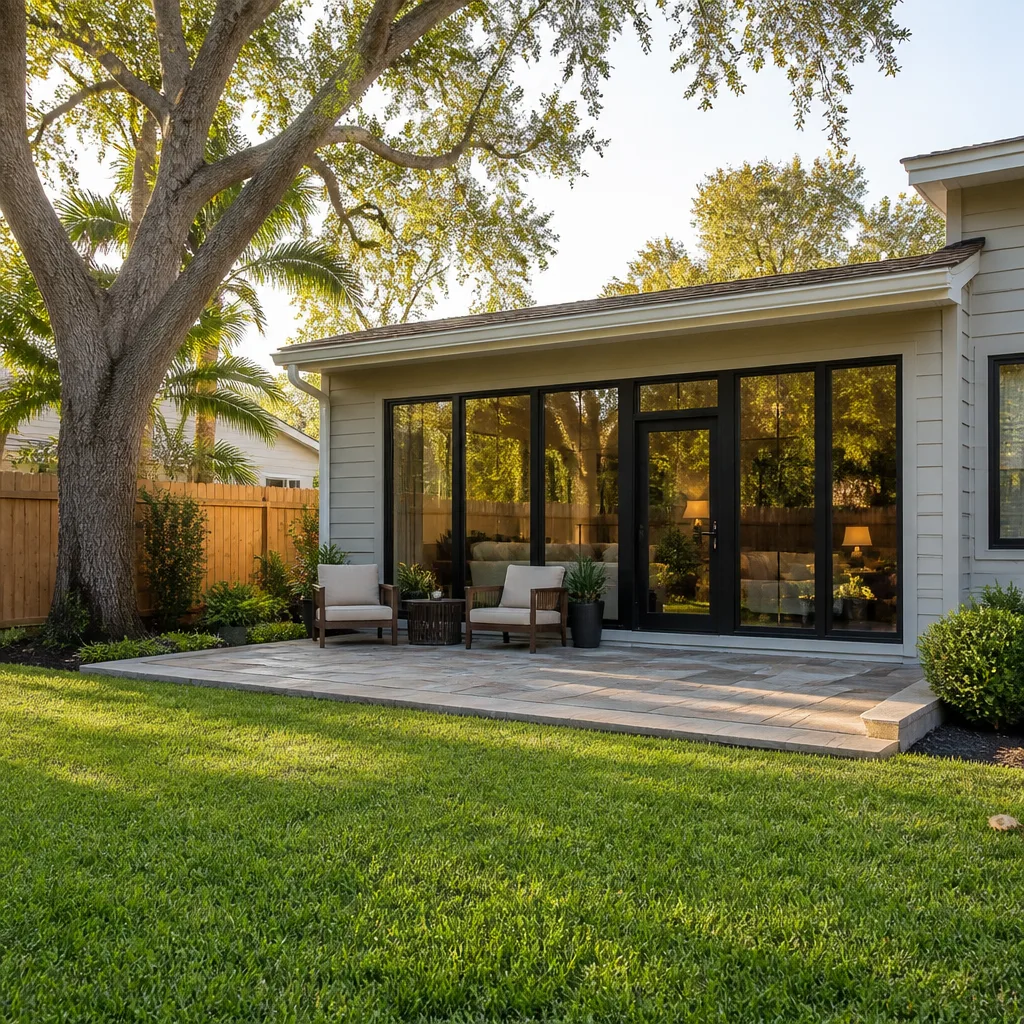
Most Sterling home addition and ADU failures we see in Fort Lauderdale aren’t the frame or the roofline – they’re the connection points: flashing transitions, tie-ins at the existing exterior wall, and door/window openings that were never flashed for a climate that gets 60-plus inches of rain a year. A Sterling addition or ADU in this market typically runs $45,000 – $130,000 installed depending on square footage, foundation work, and whether you’re tying into existing plumbing or running new lines. If you’ve got water staining at the seam where the addition meets the original house, a door that suddenly won’t latch after hurricane season, or drywall cracks spreading from a corner – those are the symptoms that bring owners to us. Here’s the truth: most of what fails on a Sterling structure in South Florida fails at the transition points, and most of it can be corrected without tearing the whole addition apart.
Which Sterling Models This Applies To
Sterling’s home addition and ADU systems are modular in design, which is both the good news and the complication. The wall panels, roof cassettes, and connector hardware are engineered to specific spans – most commonly 12-foot, 16-foot, and 20-foot module widths – and the parts that fail are usually the connectors and sealants at module joints, not the panels themselves. If you’re identifying what you have, look for a small metal plate or sticker on the interior side of a corner post, usually at knee height, that lists the series and module designation (for example, “S-1600” or “ADU-12”). That number matters more than the year. We keep a log of Sterling series specifications and can match your existing module from photos and measurements in most cases. One gotcha we run into regularly: Sterling changed their flashing profile in 2019, and the older L-flashing doesn’t mate cleanly with the newer J-channel without an adapter strip. If a previous contractor patched a seam with whatever was on the truck, that’s usually where the leak starts.
We’re an independent remodeling contractor serving Fort Lauderdale – not a Sterling dealer or factory rep – but we’ve worked on enough of these structures to know which OEM connectors are worth paying for and where a quality aftermarket equivalent does the same job for half the price. For structural connectors and anchor bolts, we use OEM or spec-identical equivalents. For sealants and flashing, we often upgrade beyond the factory spec because Fort Lauderdale’s humidity and salt air demand it.
Styles & brands we work with







Signs Your Sterling Home Additions & ADU Is Failing
- Water staining or efflorescence at the wall-to-wall seam. This is the most common failure we see. The flexible sealant between the original house and the addition cures, shrinks, or was never properly tooled, and wind-driven rain from afternoon thunderstorms gets forced into the gap. The white chalky residue is mineral salts from the concrete or masonry behind it.
- Door or window that binds or won’t close in summer. South Florida’s wet-dry cycles cause the soil under a slab-on-grade addition to expand and contract. If the addition wasn’t tied to the existing foundation correctly, the frames rack and the doors bind. This is a structural symptom, not a hinge problem.
- Drywall cracks radiating from a corner or along the ceiling line. Some settling is normal in the first year. Cracks that reopen after repair, widen past 1/8 inch, or run diagonally from a window corner usually mean the module connection is moving more than it should.
- Musty smell that returns after cleaning, especially in one room. That odor usually comes from moisture trapped behind a wall panel or under flooring. By the time you smell it, the leak has been active for a while. The source is often a failed flashing transition you can’t see from outside.
- Gap opening between the addition’s eave and the original roof line. If you stand back and the rooflines no longer look parallel, or if a gap opens up at the soffit that wasn’t there a year ago, the addition is moving independently from the main structure. That should never happen on a properly tied-in build.
See the difference
 Before
 After
After Before
 After
After Before
 After
AfterReplacement Cost & What’s Included
For Fort Lauderdale specifically, expect to budget $45,000 – $130,000 for a full home addition or ADU project built to current code – and understand that the low end assumes a simple room bump-out on stable soil with no plumbing, while the high end reflects a full ADU with kitchen, bath, and separate utility connections. What drives the number up or down faster than anything else is the foundation: Fort Lauderdale’s high water table means many additions need either reinforced slab work or a stem-wall foundation, which adds real cost before the first wall panel goes up.
| Work Scope | Typical Range in Fort Lauderdale | Key Cost Drivers |
|---|---|---|
| Home addition (small, no plumbing) | $45,000 – $75,000 | Foundation type, module size, roof tie-in complexity |
| Home addition (with bath or kitchen) | $60,000 – $130,000 | New plumbing runs, fixture grade, floor covering |
| Full ADU (studio or 1-bed) | $90,000 – $220,000 | Separate utility service, code requirements, site access, impact windows |
| Garage conversion | $30,000 – $80,000 | Floor elevation, insulation, egress windows, HVAC |
Every job we quote for a Fort Lauderdale homeowner gets a written price before we start – not a range, not a verbal ballpark. The number on day one is the number on the final invoice, because that’s how Penhallow has operated since the Kingswell family of companies set its standard in 2004. The work carries our 365-Day Done Right Promise: if something fails inside that year, we come back and fix it at no charge. That promise is in writing, on every job.
DIY or Call Us?
Some things on a Sterling addition you can check yourself safely: resealing a visible gap with a quality polyurethane sealant, clearing debris from a roof transition, or marking a crack with a pencil to see if it’s still moving. Those are owner-level tasks. What you shouldn’t attempt yourself is anything that involves removing wall panels to trace a leak, cutting into a roof transition, or adjusting structural connectors – the panels on these systems carry load, and if you pull the wrong fastener, you’ve created a bigger problem than the one you started with. I’ve seen it happen in Fort Lauderdale more than once. If water’s involved and you can’t see the source from the outside, call us at (754) 551-2922. Trevor Nash and the team can find the source of a leak faster than you’d think, usually without ripping the drywall off a guess.
FAQs
With proper installation and maintenance, the structure itself should last 40 – 50 years in South Florida’s climate; the components that need attention sooner are the sealants and flashing, which typically need reworking every 8 – 12 years in Fort Lauderdale’s rain and sun exposure. Call (754) 551-2922 for an inspection if yours hasn’t been looked at in a decade.
In most cases it can be repaired – the modular design means failed connectors, flashings, and sealant joints can be replaced individually without dismantling the whole structure. The exceptions are severe foundation movement or rotted panel cores, which we’ll identify honestly before recommending any repair path.
A typical flashing or sealant repair takes one to two working days; a structural connector replacement or foundation correction can run one to three weeks depending on scope, permitting, and weather. We’ll give you a written timeline before we start, and we show up in the window we gave.
We keep the common connectors, flashings, sealants, and fasteners for Sterling home additions and ADUs on our service vehicles, so most repairs can start the same day we diagnose the problem. For uncommon series-specific components, we source directly and have them within a few business days.
If your Sterling addition or ADU in Fort Lauderdale is showing signs of trouble, call (754) 551-2922 for a free estimate. Tell me what you need, I’ll tell you what it costs – then we’ll get it done. A real person answers, we’ll schedule a visit that fits your week, and you’ll get a written price before anything is touched.
Written by Trevor Nash, Owner, Penhallow Remodeling Fort Lauderdale at Penhallow Remodeling Fort Lauderdale, serving Fort Lauderdale and nearby areas.


